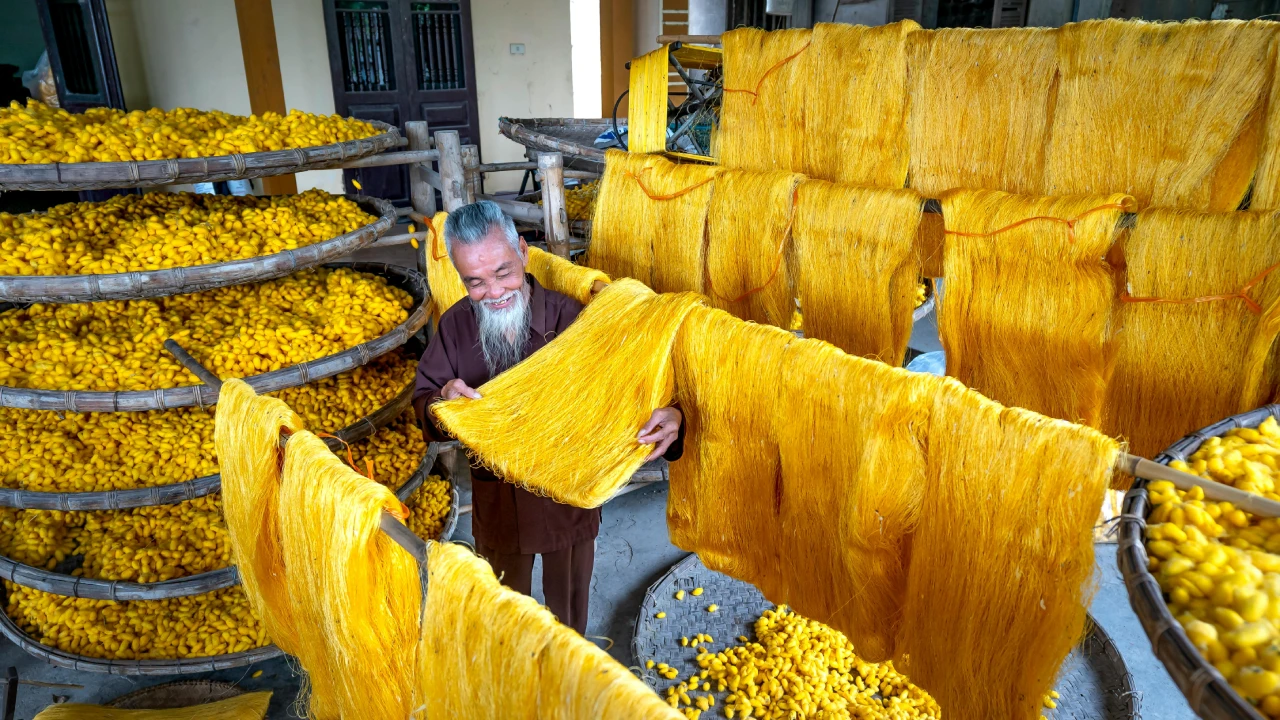
Article written by a passionate reader for “Testimonianze”, the column dedicated to those who, like us, contribute every day to sharing the secrets of this natural and precious fibre.
The first time that, still a young boy, I entered the stately building overlooking the square of the Duomo of Ceneda, once owned by my great-great-grandfather, the first mayor of Vittorio Veneto, I was surprised to discover that its inner courtyard and the large adjacent fields unexpectedly gave it a rather rural appearance. Signs of farming activity were still clearly visible in the tool sheds built dry along the walls and in the small red farmhouse dedicated to the stables.
Inside the palace, the main floor was heated by a single large fireplace and an old wood-burning kitchen. The attics, on the other hand, contained numerous small fireplaces with a strange conical shape. What were they for? What was the purpose of heating attics?
“So that the eggs could all hatch on the same day, and the newborn silkworms would be protected from excessive humidity and temperature fluctuations.” My father’s unexpected answer plunged me into a story that until then had been completely unknown to me: the fabulous world of silkworms, known as “cavalier”. This was a story that concerned all the people of Vittorio Veneto, because the population was deeply involved in this productive sector. I discovered that skeins of silk were shipped from Vittorio Veneto to Austria, the Balkans and Russia, but also to Northern European countries and America.
Evidently my great-great-grandfather, as a conscientious first citizen, also committed himself to making his contribution. He was among the few fortunate ones to own attics with fireplaces entirely dedicated to the care of the “cavalier”.
Most of the more modest farming families, who significantly supplemented their income through the sale of cocoons, were forced to raise silkworms in the rooms of their homes. Stories were passed down of the precious tiny eggs, known as silkworm seed, which were brought to term by keeping them in bedrooms, under mattresses or between the folds of blankets.
Raising silkworms was not an easy task and required the involvement of all family members: some would book the silkworm larvae in advance in order to collect them at the moment of hatching, while others purchased the eggs, the silkworm seed, and ensured they were kept warm during the delicate incubation period. The silkworms were then raised on mulberry leaves for about 30 days, but care continued for a further 10 days, during which the worm spun its cocoon, anchoring it to thin, dry twigs used to create the so-called “forest”.
In the second half of the nineteenth century, when our region was part of the Kingdom of Lombardy-Venetia, a devastating epidemic spread throughout Europe, affecting silkworms and wiping out cocoon production. Sericulture was able to recover only thanks to specialised institutes responsible for monitoring the health of the eggs and producing silkworm seed which, by law, had to be certified as healthy in order to be used.
The city of Vittorio Veneto soon excelled in this activity and became the most important centre for silkworm seed production in Italy after Ascoli Piceno. The hills and the upper plain saw an enormous expansion in mulberry cultivation, which contributed to overcoming a closed economy based on subsistence.
Thanks to silkworm farming and the economic security it provided, the rural household gradually transformed into a centre of family-based artisanal production. A socio-economic phenomenon that contributed to transforming the life and culture not only of my hometown, but of many villages scattered throughout the Italian peninsula.
Sericulture had a profound impact on our communities, helping to shape working habits, economic practices and organisational structures that are still recognisable today, and above all fostering a spirit of cooperation, both within families and across the community. The first cooperative forms arose precisely in connection with silkworm cultivation. The life cycle of the silkworm, which inside the cocoon transformed into a chrysalis and then into a butterfly according to a precise timetable that allowed no margin for delay, made it necessary to rely on cooperative systems. The so-called “incubation chambers” were established for distributing newly hatched silkworms to farmers, along with “cocoon drying facilities”.
Thanks to the continuous emergence of spinning mills, where skeins of raw silk were produced, many women found, for the first time, employment opportunities outside the walls of their homes. A true revolution, centred around a textile fibre with a millennia-old history that today fascinates more than ever.
As evidence of the importance of silkworm cultivation in my native territory, Vittorio Veneto hosts two beautiful museums.
The first, public, is located in the former Maffi spinning mill in San Giacomo di Veglia. The museum preserves traces of personal and collective memories, recounting for new generations the complex agricultural, industrial, scientific and social world that for a long time revolved around the fabulous world of the silkworm and its magnificent product: silk.
The second, private, is located in the complex of the Marson Observatory and Sericulture Institute in the Meschio area and documents the history of the industry dedicated to the production of silkworm seed which, between the nineteenth and twentieth centuries, shaped the city of Vittorio Veneto for a century.